Living in Fear

Before I started this blog, I had a dream of writing. This dream was always a pipe dream; something I thought about often but did not think could be a reality nor was I taking any steps to make it happen for myself. I was living in fear. This fear was fed by beliefs that I had. Your high school English teacher that one year told you that you would only be a good writer never a great writer. You don’t have enough experience to make a difference in people’s lives. Nobody would read it anyway. These beliefs kept me stagnant. They formed a safety net for me to fall back on if I never achieved the dream. I was preparing myself to fail before I even started the journey just to cushion the blow to my ego if I failed.

            In life, we often act from this protective, defensive stance. We create beliefs about an experience that tell us what is possible in life. As explored in the theory of social constructionism, these beliefs can be formed from past experiences, messages we receive, societal standards, and institutionalized beliefs and limitations. We absorb these messages like a sponge, silently creating the beliefs around what we perceive to be a possibility for us. We protect ourselves from failure, from the opinion of others, or from getting hurt by someone. We hold back, we censor, and we live in fear at times. Now I am asking what if we acknowledge these things, and do the things we want to do anyway?

            This brings me to the idea of mindfulness. Mindfulness has become a buzzword in mainstream society. Mental health techniques go in and out of style like the cut of our jeans and the current trend is having a mindfulness practice. This leads to a lot of misconceptions. What does it actually mean to be mindful? I bet you anything that when you think of the word a stereotype of a yoga practicing, green juice drinking person who oozes a constant state of peace and zen comes to mind. For some people that is how they find mindfulness and the more power to them, however, for most I am going to tell you to throw that image out the window.

            Mindfulness is leading life with intentionality. Mindfulness is bringing attention to the underlying emotions, making an effort to validate them, making an effort to understand them and making a choice that is purposeful rather than driven by reactivity. I say, “making an effort” because as humans this is a challenging thing to do. The goal is to make tiny steps towards small realizations that we have choice in life. We may not be able to control what happens in our environment, but we are able to control our reactions and behaviors with practice over time.

            I ask you to explore your safety net of beliefs that keep you in your comfort zone. What might these beliefs be protecting you from? Allow yourself the space to thank your brain for protecting you and doing such an awesome job at it. Give yourself permission to bring some understanding into that space and to feel gratitude to yourself for keeping yourself “safe”. Face the fear that is there and make the choice consciously rather than reactively. Even if you just notice it, that is progress.

            About one month ago, I created a blog on what I thought was a free site thinking, “Well if I don’t do it, it does not matter because it is free”. Then my credit card was charged for the subscription. Oops. I had a choice to make. I could stop and let the fear keep me in my safety net or I could push forward, acknowledge that this scared me, and write. Every week I face my fear and write about some thoughts that I have. Each time I am building up my confidence in myself that I can be a little scared, acknowledge it and do it anyway. I am a person who can do things that scare me and so are you. I want to hear about the ways you challenge yourself and face your fears down below!
Why Am I So Tired, I Didn’t Leave My House?

“Why am I so tired, I didn’t even leave my house today?” This is a question I have heard many times over the last two weeks. It is a question I have asked myself as well. For some reason, the last two weeks have hit a little bit harder for myself and the people in my life. The novelty of quarantine and working from home has worn off and staring at a screen instead of human to human connection, is getting a little bit old after staring at a computer screen all day. But why am I so tired? I didn’t even leave my house today.

The current state of the world is something that we have never lived through before. Everything is new and unexpected; there is an incredible amount of uncertainty. On one hand, there are moments of gratitude. Gratitude for being able to work from home, for a full fridge, for being able to stay safe in a comfortable environment without a disproportionate amount of fear. These are thoughts I think daily. I think of how the mild loneliness and discomfort of a disrupted routine are small in comparison to challenges others might face. And while many can acknowledge these things, there is a frustration that permeates the boundaries of our minds at times.

Frustration and anger are a natural response that our body feels when faced with a lack of control. At times, we channel our lack of control and grounding into an emotion that feels charged and powerful. Anger and frustration can feel safe in times of uncertainty. It feels like something powerful when we need it most. Grief, loss and sadness on the other hand fill our hearts with helplessness, uncertainty, and fear. As a result, we reach to frustration as a natural buffer to these negative feelings. This is our way of creating safety and security for ourselves.

So, why are we so tired? We are tired because our safety and security has been shaken to varying degrees. We are tired because this is not how we imagined our spring of 2020. We are having to let go of the attachment to our imagined futures, while images of how spring was supposed to be are competing with how spring of 2020 actually is. We are working through the trauma of uncertainty that makes it nearly impossible to plan ahead and create expectations that bring peace and calming to our nervous systems. We are in overdrive.

We are in overdrive every time we look at a screen and it is a reminder of how life is “supposed” to be. We are in overdrive every time we walk past someone in a mask that our brain interprets as danger. We are in overdrive every time we try to go on as normal even though life is very much “not normal” currently. Some days the overdrive is not as bad and we are “fine”. Most days are fine. However, if that anger and frustration rears its roaring head know where it is coming from. Know your body is doing its best to make sense of a situation that it does not know, a situation it has no reference point for.

“So, what do I do about this?” you might ask. What is the antidote to trauma? Hope. Hope is banging pots and pans and cheering for healthcare workers at 7:00pm every day. Hope is celebrating National Jellybean Day even though nobody does that. Hope is looking for the good in today and tomorrow. Hope is learning to dance in the rain. Sometimes, hope is saying today was rough, and I will try again tomorrow.

Know your Limits

Throughout our life we accumulate different parts of ourselves. These labels become our “I am’s”. Very often, some of our most important “I am’s” come from the opinions of other people. Usually these are people that we value greatly in our lives such as parents, teachers, friends, bosses, and coworkers. Their opinions matter to us due to the important roles that they play in our experience. While these beliefs are important in forming identities and giving us a firm sense of self, they can also aide in creating our limiting beliefs.

            We all have limiting beliefs about ourselves. These thoughts are beliefs about ourselves that we hold to be true based on experiences, opinions and past belief systems. Mostly these beliefs really support who we are as humans. They help us to know where we belong and who we belong to. A sense of comfort can exist in knowing these things about ourselves. However, when these beliefs do not align with who we feel that we are at our core they can bring about uncertainties, conflicting beliefs, inner conflict and feelings of resentment. On a more simplistic level, they contribute to feeling unfulfilled with our current state of life. At times these beliefs can be holding us back from embodying our truest, most authentic selves.

            These beliefs can be so engrained in our way of thinking that we do not realize the impact that they have on our self-esteem or interactions with others. In order to change our behaviors and relationships with others, we need to call forward our limiting beliefs and bring them to the forefront of our attention. When we call something forward and cement its existence in language, we are able to then challenge these beliefs to fit who we are in the present moment. We then have the power to mold our beliefs about ourselves to support our authenticity.

            As we begin to challenge our limiting beliefs about ourselves we can then assign them to their rightful owner. Maybe the beliefs you hold to be true about significant relationships in your life belong to your grandmother who struggled with maintaining supportive relationships throughout her life and passed that belief on to you. Perhaps you believe that life is supposed to be hard and challenging because it is a family theme that developed throughout your childhood. As we start to bring awareness to our belief systems, we allow ourselves the opportunity to choose the beliefs that align most with who we are.

            Beginning to think about these beliefs can feel overwhelming. However, I am not talking about your preference for chocolate ice cream versus vanilla ice cream or the fact that you prefer shades of blue over orange hues. You can start by thinking about the beliefs you have about yourself when you think to yourself “I can’t…” and ask yourself why you believe that to be true. A small amount of questioning can bring about new opportunities. It’s all about knowing your limits and shining light on your strengths.

Let’s chat in the comments below!

Holding the Space

When learning the craft of therapy, one of the most abstract concepts to learn is the act of “holding space”. In essence, this means creating the environment to allow for emotional expression to occur. In school, it often felt like doing nothing. How can you hold space for someone else’s pain? Shouldn’t I be saying something profound, doing an intervention, or reframing an idea? At the time, I did not know the power that lies in bearing witness to an emotion.

            There is healing in someone witnessing your pain; healing in validation. However, it is something that often brings up discomfort for others. As human beings, we do not like to see others suffer. We want to fix others pain, cheer them up, or help them to get over it. And while dwelling on negativity is not something to strive for, there is healing in bearing witness and in being seen.

            So, what does it actually mean to hold space? Holding space is listening to understand rather than listening to respond. It means seeing an emotional experience with unconditional positive regard and non-judgement. It means giving an experience room to breathe and be seen. There is something magical that happens when someone feels the space to be able to be understood and share their emotional experience with another without judgement, a space that can contain even the ugliest of emotions.

            We are trained in society to see emotions as confusing and something to rid ourselves of rather than to understand. This perpetuates a theme of stigma and misunderstanding. I see emotions as information; information from our brain about our bodies interpretation of our environment, current or otherwise. Information that we should pay attention to. If we are able to hold space for others, what happens when we hold the space for ourselves? It is possible to give ourselves permission to learn to sit with something and to feel more than one thing at a time.

            A popular children’s movie, Inside Out (2015), explored this theme of feeling more than one emotion well. The movie depicts the inner working model of a child’s brain using cartoon characters to represent emotions that the child experiences. The memories create globe like objects colored with the emotion it represents. At the beginning of the movie all of the emotions are singular in color, neatly stacked in rows to represent the brain. Sadness is seen as the wet blanket of the group, always getting into trouble for touching things and turning them blue. As the child grows and the movie evolves, memories become globes tie-dyed with colored mist representing the complexity of the human experience.  

           During a time in society when we are faced with so many conflicting emotions, let’s give ourselves the gift of holding space for ourselves. Let us allow ourselves the ability to be both positive and frustrated with the current state of our lives, or to feel happiness and sadness all at the same time. Maybe instead we give something a name and try to get to know it a little bit better. Maybe we learn the art of holding space and creating tie-dye.

Maybe You Should Slow Down

A few weeks ago, I was running several minutes late after squeezing in an appointment before work. I came to a sign on the intersection saying, “Do not enter”, surrounded by a circle of orange traffic cones halfway blocking the street. I pass by this obstruction in the quiet, suburban neighborhood twice a day, always questioning its purpose. I religiously decide to take the long way around and make the right at the stop sign to the next parallel road. It adds approximately 30 seconds to my drive. That day, I paused at the stop sign contemplating the most direct route to my destination. I peeked to my left and to my right, and checked the empty street ahead which consisted of a parked SUV on the side of the road completely abandoned. I pushed the gas and ran the sign. Approximately 15 minutes later I arrived at work with my traffic ticket in hand issued by the seemingly “abandoned” SUV. I arrived much later than the 3 minutes I would have been had I observed the traffic signs. My mother’s voice rang in my head, “Don’t speed if you are late, you’ll be even later if you get a ticket!” Thanks, Ma, I chuckled to myself.

The point of the story is not to highlight my poor driving decision that morning or the fact that, at a young 25, my prefrontal cortex is maybe not as completely developed as I would have hoped, but to bring attention to the chaos of the day to day. I sent a text to my sister expressing annoyance at myself, “Why did I do that?” and “That was so dumb”. She replied by laughing and saying “Lydia, maybe you need to slow down.”

Slow down… me? I thought to myself. I pride myself on being notoriously scheduled. I have a morning routine that is built around mindfulness practice and self-care. I meditate, I go to the gym, I visit my chiropractor all in the name of health and wellness scheduled almost to the minute. Meditate for 20 minutes, set a timer, leave for the gym by 8:30am, get back in my car by 9:30 am, leave for work by 10:30 am. It works like clockwork. Why would I need to slow down?

The thought stayed with me throughout the week ahead. I went through my routine as usual; walk dog, breakfast, chug the coffee, meditate, gym, leave for work. All perfectly syncopated like a self-care machine. I started to notice the slight eagerness in my chest as I set my timer to meditate and the way in which I walk at a slight run between scheduled activities. Rushing, I am always rushing.  Rushing to meditate to reach awareness of my breath while also being slightly aware of the next thing on my list that is standing ready, at attention for me to continue on. I started to notice the slight pressure on my skin and the rush of thoughts saying “okay, what’s next” as I go throughout my day. It’s uncomfortable. “Why am I always rushing? And to what?” I asked myself. And then, the world stopped.

COVID-19, also known as the Novel Corona Virus, appeared to sneak up on us. On Wednesday, I remember joking with my boss about the thing we yet had very little understanding of and by the next Wednesday schools were being closed and we were working feverishly on implementing a Telehealth program for our clients that would usually take months to set up. My boss set it up in about a week. We shifted into high gear in a short amount of time. It was as if the world turning on its axis, stopped as abruptly as a spinning coin that fell on its side. The world was forced to slow down. Even as the world was forced to slow down, we sped up with the asking of questions such as “How do we accommodate our clients?”, “What about electronic paperwork?”, “How do we be present and assess risk through a computer?” and, “Is this HIPAA compliant?”. A rush of questions filled the space that was forced open in the slowing down process. Most presently the question of, “What do I do next now?”.

Thoughts filled my brain about how to be productive during this time. Maybe I would do more yoga, and read all of the books I have been wanting to read. Maybe I would write a book, organize my closet and find nirvana all in the same day. I would make Quarantine fit my schedule. I sat with this idea for the first week I was home and to my surprise I was busier than ever with work and had no time to read, or organize, and definitely no time to find nirvana. I was in quarantine and couldn’t find the time to meditate. And then I remembered, “Lydia, maybe you should slow down”. I thought about the discomfort that accompanies that statement. How the rush inside my chest starts to bounce alive when I sit in silence, searching for the next project to accomplish or task to check off of my list. And I sat with it. I started to think about the discomfort and give it the space to exist in the slowing down process. I questioned what I was left with when the social aspects of life, work and family are all distanced. For some, there is anxiety in this place, for others a sense of loss or grief, and for some a comfort of taking a break from the day to day. I think I rotate through all of these emotions at least once per week, mostly depending on the day.

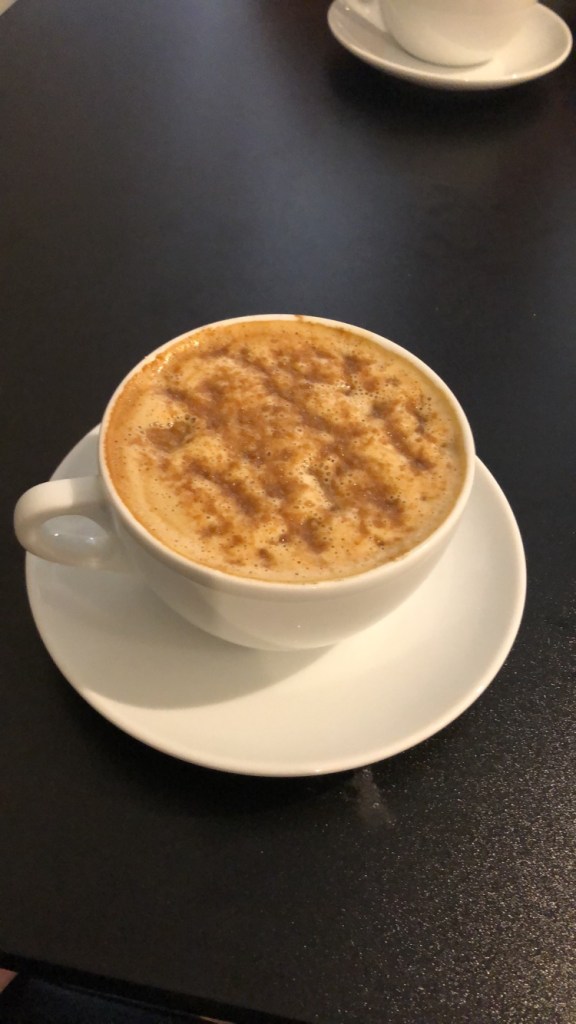
We, as people, are faced with so many pressures throughout our life. Pressures including success, achieving happiness, getting that promotion, having a family, making sure you do these things in the right order and not too early but also not too late. We hold ourselves accountable to a societal timeline of life. I wonder how this will change if we start to hold ourselves accountable to ourselves. I am curious about how life and meaning can shift when we start to explore what lies underneath the chaos of everyday life. This is a time that brings attention to the social nature of human beings and the vital importance of meaningful connection. I wonder how much we shall connect with others once we start connecting with ourselves. So today, instead of chugging my coffee, I took the time to make coffee like my Grandpa with a hint of cinnamon and chose to sip it instead.

Grandpa’s Coffee Recipe

2 tablespoons of coffee grounds

6-8 oz water

Cinnamon

Honey

French press

Place coffee grounds in press, add cinnamon and honey to taste, add boiling water. Let sit for five minutes. Press and pour.